
Muong Hoa Valley Trekking Guide — What You're Walking Through
Before you drop off the Sapa ridge into Muong Hoa, know this: you are walking into a working farm valley, not a single painted trail. Lao Chai and Ta Van sit on every day trek we run; Y Linh Ho shows up when you have longer hours; Giang Ta Chai is the Red Dao overnight. The terraces look like scenery. Underfoot they are someone else's rice calendar.
Local expert tips
- →
At the first wide terrace above Lao Chai, pause. Ridge houses one way, valley floor opening toward Ta Van the other. Learn that split once — the rest of the morning makes sense.
- →
After rain, stay on the stone lip. The flat mud in the paddy looks inviting and swallows shoes.
- →
On full-day or homestay, ask for carvings early so the stop fits the clock — they are not behind a ticket booth.
- →
If village names are still blurry, do the Town Walk the day before. The café overlook is the dry rehearsal for tomorrow's descent.
- →
Harvest weeks fill the same paths and the same guides. Email confirmation beats hoping the valley will be empty for you.
Valley overview — for travellers about to walk
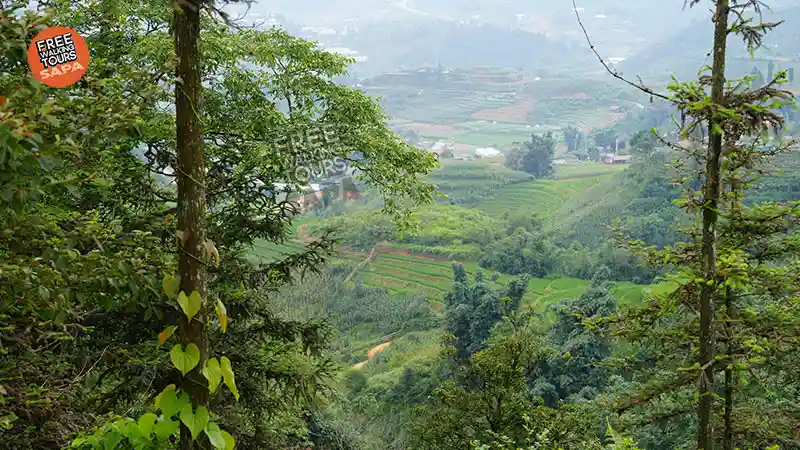
Muong Hoa sits southeast of Sapa town, dropping toward the Fansipan massif inside Lao Cai province (Vietnam National Tourism — Sapa). From a café on the ridge you see layered rice terraces. From the path you smell wet earth, hear buffalo bells, and pass houses where indigo cloth hangs to dry.
**What you are walking through:** a highland farming corridor. Paths link villages. Water moves between paddies. People plant, weed, and harvest around your boots.
**What you are not on:** a national-park boardwalk, a Fansipan summit approach, or Cat Cat's separate ticketed downhill loop. Valley farms sit below the Hoang Lien park core — related mountains, different day.
**Is it worth it?** If you came for terraces and highland village life, yes — this is the corridor those photos come from. If you only want town coffee, stay up on the ridge and be honest about it.
What you are looking at while you walk
**On the descent from town** — paved gives way to stone and dirt. The first open terrace edge is your orientation stop: Lao Chai ridge country ahead, valley floor opening later toward Ta Van.
**Through Lao Chai** — Black H'mong houses, indigo, hemp work when families are home. Mid-morning this stretch carries the most trek groups. Look at the terrace walls as engineering, not wallpaper.
**Toward Ta Van** — the floor widens. Giay stilt houses sit lower. Streams and short bridges appear more often. Light holds longer here for photos if your group is not racing.
**On longer days** — side paths toward hamlets such as Y Linh Ho. Same valley character, fewer people than the Lao Chai funnel.
**On the overnight route** — past Ta Van toward Giang Ta Chai (Red Dao). Red headscarves, different house feel, dinner in a family home — not a day-trek add-on.
Rough timing from town to the rim: 30–45 minutes on foot. The real day happens after that drop.
Village comparison
| Place | Community | Which routes | What you notice on trail |
|---|---|---|---|
| Lao Chai | Black H'mong | Half-day, full-day, homestay | Ridge terraces, indigo, busiest morning stretch |
| Ta Van | Giay | Half-day, full-day, homestay | Wider floor, stilt houses, softer photo light |
| Y Linh Ho | Highland hamlet on longer loops | Full-day (extended) | Extra quiet ground when hours allow |
| Giang Ta Chai | Red Dao | Homestay | Overnight; not on published day treks |
You do not choose Lao Chai **or** Ta Van on a half-day — the path links both. Ridge chapter, then floor chapter.
More culture depth: ethnic groups guide.
Trek route comparison
| Route | Time / distance | Ground covered | Choose it when… |
|---|---|---|---|
| Half-Day | ~3 hours walking (~4–5 hours total including breaks and village stops) · $25/person | Lao Chai + Ta Van | First valley day; need the afternoon |
| Full-Day | ~6–7 hrs · $55/person | Same spine + Y Linh Ho / extra viewpoints | Photography; trekking is the whole day |
| Homestay | ~5–6 hrs Day 1; ~16–20 km total · $95/person | + Giang Ta Chai overnight | Dinner, morning mist, Red Dao chapter |
Same valley — different hours and whether you sleep down there. Detail on the day pair: half-day vs full-day. First-visit framing: best trek for first-timers. Overnight honesty: homestay what to expect.
Countryside Walk (Suoi Ho / Ma Tra) is near-town path country — cousin terrain, not the main Muong Hoa drop.
Difficulty, terraces, streams, bridges
| Route | Walking time | Elevation change | Fitness |
|---|---|---|---|
| Sapa Town Walk | ~2.5 hrs, flat | Minimal | Anyone mobile |
| Countryside Walk | ~3 hrs, gentle | Light ups/downs | Easy |
| Half-Day Trek | ~3 hours walking (~4–5 hours total including breaks and village stops) | Downhill start, village paths | Moderate |
| Full-Day Trek | ~6–7 hrs | More distance, same terrain | Moderate+ |
| 2-Day Homestay | ~5–6 hrs day one | Same valley, overnight | Moderate |
| Fansipan 2D1N | 2 long days | Steep alpine sections | High |
Data reflects routes our guides lead weekly — not third-party trail apps.
**Terraces** — walk the stone edges. Planted water is not a shortcut. **Streams** — you cross and skirt them on the floor; wet shoes happen when people ignore the guide's line after rain. **Suspension bridges** — short and practical on longer and overnight routes, not a bungee sideshow. **Animals** — buffalo, dogs, chickens, birds. Give livestock space; ask before you approach.
Day routes need steady footing, not mountaineering. Homestay Day 1 asks for more hours. Fansipan is another conversation.
Habits that keep days calm: trekking safety.
Best viewpoints
| Viewpoint | Best when | What to look for |
|---|---|---|
| First terrace edge above Lao Chai | Clear morning | Whole corridor orientation before close-ups |
| Mid-ridge Lao Chai paths | Green or gold season | Classic layered paddies — arrive early |
| Ta Van valley floor | Soft light on full-day | Houses + open terraces in one frame |
| Stream / bridge crossings | After light rain | Reflections — footing first, then camera |
| Homestay approach / dawn | Overnight guests | Mist texture even when Fansipan hides |
Colour peaks: green Mar–May; gold late Aug–Sep. Winter mist is a different picture, not a failed one.
Ask before portraits. Paths cut through work — cameras are guests here.
Stone carvings on the path
Some boulders carry old carvings — spirals, figures, terrace-like marks still debated by researchers (Lao Cai Portal). Provincial heritage, not a UNESCO ticket booth.
Without a guide you walk past them. On full-day and homestay, ask early. Do not chalk, climb, or scrub the rock for a cleaner shot.
Seasons, weather, farming calendar
| Season | What the valley shows | How it changes your walk |
|---|---|---|
| Mar–May | Green planting | Mild; strong first-timer window |
| Jun–Aug | Lush + wet afternoons | Grip shoes; start mornings |
| Late Aug–Sep | Golden harvest | Busiest; confirm guides early |
| Oct–Nov | Clear spells, post-harvest texture | Excellent walking weather |
| Dec–Feb | Mist, cool, fallow/brown | Shorter days; warm layers |
Rain chooses footwear. Farming chooses who you meet on the path. Neither usually cancels the valley.
Month planning for the whole trip: best time to visit.
Real traveller scenarios and itineraries
| You are… | Walk this |
|---|---|
| First visit, three nights | Town Walk, then half-day Lao Chai–Ta Van |
| Photographer with one clear day | Full-day; slow at Ta Van |
| Want overnight culture | Homestay — ideally after a shorter valley day |
| Family, kids ~8–12 | Half-day; countryside as a second easy day |
| Solo | Half- or full-day in a small group — email dates |
| Crowd-averse | Early full-day start, or countryside before Muong Hoa |
**Tight two nights:** arrive → optional Town Walk → half-day → leave. **Ideal three nights:** Town Walk → half- or full-day → buffer or start homestay. **Culture-first:** Town Walk → half-day → homestay overnight.
Responsible baseline: licensed guide, price in writing, ask before portraits, stay on paths, no litter in paddies. Homestays are family houses. Booking: how to book safely.
Practical logistics
**Meet** — Sapa town; briefing with your guide, not a random trailhead pin. **Carry** — grip shoes, rain shell, 1–1.5 L water (more on full-day), sun protection, small cash. **Leave behind** — hard suitcase on overnight; smooth sandals. **Guide** — English-speaking local guide on published routes; mist hides forks near villages.
Packing list: packing guide.
Sources & references
We separate our on-the-ground experience from official tourism and operator information. Prices and routes on this site reflect our published tours — not third-party listings.
- Official sourceVietnam National Tourism — Sapa — Destination overview and official tourism context for Lao Cai province.
- Official sourceLao Cai Portal — Provincial government portal for Lao Cai, which administers Sapa district.
- Our experienceSapaTreks guide team — On-trail village and pacing notes from guides who lead Muong Hoa routes weekly, including Sung.
- OperatorHalf-Day Easy Trek — Published Lao Chai–Ta Van day route and from-price.
- OperatorClassic Full-Day Valley Trek — Published longer valley day including extended hamlets.
- Operator2-Day Homestay Trek — Published overnight distance and Giang Ta Chai sequence.
Common mistakes to avoid
- ✕Looking for one official Muong Hoa hiking trail — you are on farm paths that fork near houses.
- ✕Expecting Giang Ta Chai on a half-day — Red Dao overnight country is the homestay route.
- ✕Calling Cat Cat 'the valley trek' — different downhill site, different tickets, different story.
- ✕Stepping into planted paddies for a photo — you are walking through someone's work.
- ✕Assuming winter closes the valley — mist and fallow colour, not a locked gate.
Frequently asked questions
- What is Muong Hoa Valley?
- The working rice-terrace corridor southeast of Sapa town in Lao Cai province. Most Sapa valley treks walk farm paths through villages here — not one marked national-park trail, and not the Fansipan summit route.
- Is Muong Hoa Valley worth visiting?
- Yes if terraces and highland village life are why you came. Walking the paths is different from seeing the valley from a coach or café. If you only want town time, you can skip it.
- Which villages are inside Muong Hoa?
- Day treks centre on Lao Chai (Black H'mong) and Ta Van (Giay). Full-day loops add hamlets such as Y Linh Ho. Giang Ta Chai (Red Dao) is on the 2-day homestay route.
- How difficult is trekking here?
- Moderate village paths and terrace edges — not alpine climbing. Half-day suits most first-timers; full-day adds hours; homestay Day 1 is the longest valley walking day. Knees notice steps and the return effort.
- Half-day or full-day?
- Same core villages; different hours. Half-day finishes around lunch. Full-day adds viewpoints and ground such as Y Linh Ho. See our half-day vs full-day guide if you are still deciding.
- Can I reach Giang Ta Chai on a day trek?
- Not on our published half-day or full-day. Giang Ta Chai is on the homestay overnight route.
- Are there streams and suspension bridges?
- Yes on longer valley stretches — streamside paths and short practical bridges, especially toward the floor and on overnight routes. Wear grip shoes; follow your guide after rain.
- When is the best season?
- March–May for green terraces; late August–September for golden harvest (busier — book ahead). The valley stays walkable year-round; winter brings mist and cooler air.
- Can I trek without a guide?
- Paths exist, but forks near villages and mist hide junctions. A licensed local guide adds safety, pacing, and the village context a phone map will not.
- How does Muong Hoa compare to Fansipan?
- Valley days are agricultural paths around roughly 1,000–1,400 m. Fansipan summit routes climb much higher into alpine forest — different fitness, weather, and prep.
- Is it good for families and solo travellers?
- Half-day works for families with kids who walk confidently from about age 7. Solo travellers join small groups on published routes — email dates for a spot or written solo rate.
- What does responsible tourism look like here?
- Book licensed guides, pay agreed prices, ask before portraits, stay on paths, and treat terraces as workplaces. Homestays are family houses, not boutique hotels.